
2026/06/23
What is isophorone diisocyanate?
Polyurethane materials are used in countless industries, from automotive coatings and industrial paints to adhesives, sealants, and high-performance elastomers. The…
ادامه مطلب
Raw materials and additives of polyurethane systems
Polyurethanes are typically formed by the reaction of polyols with isocyanates. Isocyanates also react with amines in the formulation, forming urea linkages. These materials create an unstable intermediate, carbamic acid, which decomposes into amines and carbon dioxide when reacting with water. Additionally, the crosslinking (curing) process depends on the type of isocyanate structure used.


In the world of modern materials, few chemical compounds are as influential and widely used as isocyanates. From advanced construction solutions to high-performance adhesives, coatings, and elastomers, isocyanates sit quietly at the core of many products that shape daily life and industrial progress. Yet despite their importance, isocyanates are often misunderstood or oversimplified, especially when it comes to their role in polyurethane chemistry.
This article is designed to offer a clear and scientific overview of isocyanates, with a focus on their industrial relevance, commercial forms, applications, safety considerations, and especially their role as polyurethane raw materials. If you are a manufacturer, formulator, engineer, or decision-maker looking for reliable technical insight before sourcing isocyanate materials, this guide will help you build a solid understanding and confidently move forward.
An isocyanate is an organic chemical compound that contains one or more isocyanate functional groups, chemically represented as –N=C=O. This functional group is highly reactive, especially toward compounds containing active hydrogen atoms such as hydroxyl (–OH) or amine (–NH) groups. This reactivity is the foundation of polyurethane chemistry, where isocyanates react with polyols to form polymer chains with tailored mechanical and physical properties.
From a molecular perspective, isocyanates are versatile. But by carefully selecting the type of isocyanate and controlling reaction conditions, manufacturers can produce materials ranging from flexible elastomers to rigid structural systems. This adaptability makes isocyanates essential building blocks rather than finished products, clearly defining their role as core raw materials rather than ready-to-use foams or coatings.
Isocyanates can be classified based on their molecular structure into aromatic and aliphatic isocyanates; they are discussed below:
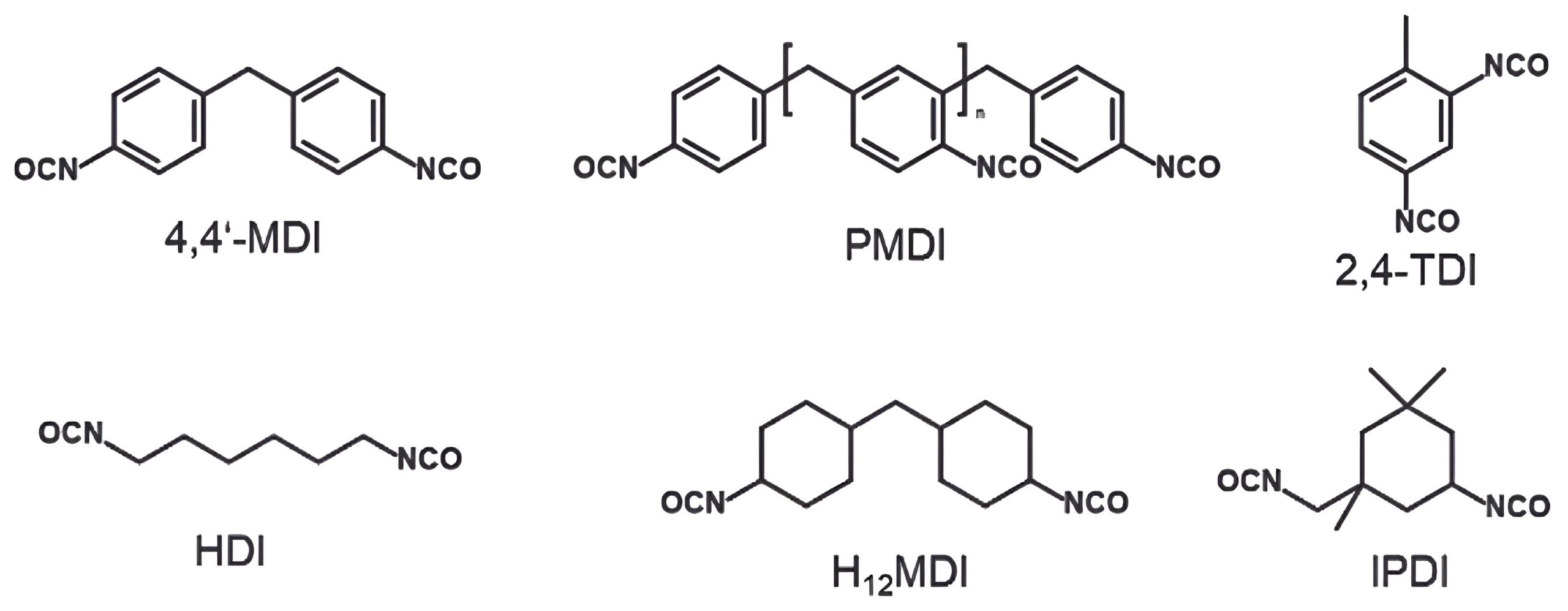
Aromatic isocyanates, such as methylene diphenyl diisocyanate (MDI) and toluene diisocyanate (TDI), are known for their high reactivity and cost-effectiveness, making them widely used in industrial polyurethane systems. However, they may show limited resistance to UV exposure, which can affect color stability in outdoor applications.
Aliphatic isocyanates, on the other hand, offer superior light and weather resistance. Although they are generally more expensive and less reactive than aromatic types, they are preferred in high-performance coatings, automotive finishes, and applications where long-term aesthetic stability is critical. Choosing between these types depends on performance requirements, processing conditions, and end-use environment. In the following, there are chemical structure of some common ones.
Isocyanates are fundamental to a wide range of industries due to their ability to form strong, durable polymer networks. In the construction sector, they are used in insulation systems, sealants, and structural adhesives that require both strength and thermal efficiency. Their controlled reactivity allows manufacturers to adjust curing time, density, and mechanical performance.
After construction, isocyanates play a key role in automotive, furniture, footwear, and appliance industries. They enable the production of polyurethane materials that combine durability with design flexibility. It has to be mentioned that in all these applications, isocyanates function strictly as raw materials that must be handled, formulated, and processed correctly to achieve consistent quality and safety.
Isocyanate prepolymers are produced through a controlled partial reaction between isocyanates and compounds containing active hydrogen. In polyurethane technology, polyols are most commonly used for this purpose because they allow precise control over reaction behavior and final material characteristics, although the chemistry itself is not limited to polyols alone.
Structurally, isocyanate prepolymers act as intermediate materials between monomeric isocyanates and fully reacted polyurethane systems. This partial modification significantly reduces the level of free monomer while preserving sufficient reactive NCO groups for later polymerization steps. As a result, prepolymers offer a practical balance between reactivity and processability.
Because of this balance, isocyanate prepolymers are widely used in applications that require controlled reaction rates, lower volatility, and improved handling characteristics. Their molecular design enables manufacturers to tailor systems for specific processing techniques and performance expectations without sacrificing formulation flexibility.
One of the most important properties of isocyanate prepolymers is their reduced free isocyanate content compared to monomeric isocyanates. This characteristic leads to lower vapor pressure and safer handling when appropriate industrial procedures are followed, making them more suitable for controlled manufacturing environments.
In addition, the viscosity of isocyanate prepolymers is a controllable parameter rather than an inherent feature. By adjusting synthesis conditions such as molecular weight and functionality, formulators can design prepolymers with viscosity levels matched to the needs of specific applications. From a performance point of view, these materials allow detailed control over mechanical strength, flexibility, and resistance to thermal and chemical stress, while maintaining good compatibility with polyols and formulation additives in different production settings.
Isocyanate prepolymers are commonly used in polyurethane systems where consistent quality and reliable performance matter. They are found in products such as industrial adhesives, protective coatings, sealants, and specialized composite materials. Because their reactivity is well controlled, they can be processed easily using both manual methods and automated production lines.
These materials are also a good choice for applications that must withstand repeated stress or contact with chemicals. Using isocyanate prepolymers allows manufacturers to create polyurethane systems that perform well over time, even in tough working conditions, without unexpected changes in processing or final properties.
Commercial isocyanates are available in several well-known grades, each designed for specific polyurethane applications. The most common examples include MDI-based grades such as polymeric MDI and pure MDI, TDI grades used mainly in flexible systems, and aliphatic isocyanates like HDI and IPDI for high-performance coatings.
These grades differ in purity, reactivity, viscosity, and free monomer content, allowing manufacturers to select materials that best suit their production needs.
In real production environments, no single isocyanate grade works perfectly for every situation. Factors such as ambient temperature, humidity, production speed, and equipment design directly affect material behavior.
For this reason, manufacturers choose specific grades—such as polymeric MDI for rigid systems or aliphatic isocyanates for weather-resistant coatings—to match local conditions and the intended application. When the right grade is selected, processing becomes more stable and the final polyurethane product will have consistent and reliable performance.
Isocyanates should be stored in tightly sealed containers and under dry conditions, because exposure to moisture can cause unwanted reactions. Temperature control is also important, since some isocyanates may temporarily crystallize or solidify at very low temperatures. For this reason, storage at an ambient temperature of around 22–25 °C is generally recommended.
Extreme temperatures, whether too low or too high for extended periods, may affect material stability and performance. In addition, once a container is opened, isocyanates can react with moisture present in the air. Therefore, it is important to reseal containers properly after use or consume the material as soon as possible after opening.
Overall, regularly checking storage containers and following basic handling rules helps keep isocyanates in good condition. When they are stored and handled properly, they stay stable over time and work the same way every time they are used in production.
Isocyanates are highly reactive materials, which is exactly why they must be handled carefully. The main risk comes from direct contact, especially breathing in vapors or allowing the material to touch the skin. If basic safety measures are ignored, repeated exposure may lead to irritation or long-term sensitivity.
In industrial practice, these risks are well known and easy to control. Using proper ventilation, wearing protective gloves and masks, and keeping containers tightly sealed greatly reduces exposure. When isocyanates are handled correctly and used as part of controlled formulations, they are reliable and safe raw materials that can be used without problems in everyday production.
Imen Polymer Chemie is a specialized supplier of polyurethane raw materials, including a wide range of isocyanate systems tailored for industrial applications. Rather than offering finished foams or coatings, our company focuses on delivering high-quality isocyanate and polyol solutions that enable manufacturers to produce consistent and reliable polyurethane products.
With deep technical knowledge and formulation experience, we support customers in selecting suitable isocyanate grades based on processing conditions, performance requirements, and regional factors. This approach ensures product quality, long-term efficiency and technical confidence for manufacturers.
Isocyanates are key raw materials used to make many polyurethane products for different industries. Therefore, knowing the basic types of isocyanates, how they behave, where they are used, and how they should be handled helps manufacturers make better decisions and avoid production issues. When isocyanates are treated correctly as specialized raw materials, they allow a high level of flexibility and reliable performance in polyurethane formulations.
In the end, it has to be mentioned that working with an experienced and reliable supplier such as Imen Polymer Chemie gives manufacturers more than just access to materials. It provides technical support, formulation guidance, and confidence that the raw materials will perform as expected. In polyurethane production, where accuracy and consistency are important, choosing the right supplier always plays a major role in the quality of the final product.